串的相关算法
Were equations, pictures or diagrams not properly rendered, please refresh the page. If the problem persists, you can contact me.
一、串的基本操作
#include <stdio.h>
#include <stdlib.h>

#define  MaxSize 100

//定长顺序存储结构
// struct typedef{
//   char str[MaxSize]; //MaxSize表示已经定义的变量,表示串的最大长度,因为多了个结束标记所以数组大小加一
//   int length;
// }Str;

//动态分配存储表示(更加常用)
typedef struct Str{
  char *ch;
  int length;
}Str;

//串的基本操作
//1.赋值操作
int str_assign(Str* string, char *ch){
  if(string->ch){
    free(string->ch); //释放原串空间
  }
  int len=0;
  char *c = ch;
  while (*c) { //求ch串的长度
    ++len;
    ++c;
  }
  if(len == 0){ //如果赋值的是空串,直接返回空串
    string->ch = NULL;
    string->length = 0;
    return 1;
  }
  else{
    string->ch = (char*)malloc(sizeof(char) * (len+1));
    if(string->ch == NULL){
      return 0;
    }
    else{
	  int i;
      c = ch;
      for(i=0;i<=len;++i,++c){
        string->ch[i] = *c; //数组直接得就是指针(详细的就不说了),这样相等完全没问题
      }
      string->length = len;
      return 1;
    }
  }
}
//2.取串长度操作
//略,直接结构体里面就有

//3.串比较操作
int str_compare(Str string1,Str string2){
  int i;
  for(i=0;i<string1.length && i<string2.length;i++){
    if(string1.ch[i] != string2.ch[i]){
      return string1.ch[i] - string2.ch[i];
    }
  }
  return string1.length - string2.length;
}

//4.串连接操作
int concat(Str* string, Str string1, Str string2){
  if(string->ch){
    free(string->ch); //释放原串空间
    string->ch = NULL;
  }
  string->ch = (char*)malloc(sizeof(char) * (string1.length+string2.length + 1));
  if(string->ch == NULL){
    return 0;
  }
  int i = 0;
  while (i<string1.length) {
    string->ch[i] = string1.ch[i];
    ++i;
  }
  int j=0;
  while (j<=string2.length) { //把结束标识也赋值进去
    string->ch[i+j] = string2.ch[j];
    ++j;
  }
  string->length = string1.length + string2.length;
  return 1;
}

//5.求子串操作(这他娘就是切片嘛)
int substring(Str* substr,Str string,int pos,int len){
  substr->ch = (char*)malloc(sizeof(char)*(len+1));
  int i = pos;
  int j = 0;
  while(i<pos+len){ //结束时候的j大小为len。下一次就不能进行了,只能自己赋值结束符号
    substr->ch[j] = string.ch[i];
    ++i;
    ++j;
  }
  substr->ch[j] = '\0';
  substr->length = len;
  return 1;
}


int main(){
  Str string;
  string.length = 0;
  string.ch = NULL;
  Str string1;
  string1.length = 0;
  string1.ch = NULL;
  Str string2;
  string2.length = 0;
  string2.ch = NULL;
  str_assign(&string1,"defsfasasf");
  // printf("%d", string1.length);
  // printf("%s", string1.ch);
  str_assign(&string2,"abc");
  // printf("%d", string2.length);
  // printf("%s", string2.ch);
  //printf("%d", str_compare(string1,string2));
  // concat(&string,string1,string2);
  substring(&string,string1,0,2);
  printf("%d", string.length);
  printf("%s", string.ch);
  return 0;
}
二、模式匹配算法
-
基本模式匹配
int Index(SString S, SString T, int pos){ int i=pos, j=1; while(i<=S.length && j<=T.length){ if(S.ch[i] == T.ch[j]){ ++i; ++j; //继续向后比较 } else{ i = i - j + 2; //关键理解点,因为是i-(j-1)+1,i递增(移动)的时候j也在递增,所以不能i+1了事。i-(j-i)就是i开始 j = 1; //时候的位置,+1就是i前进一位 } } if(j>T.length){ return i - T.length; //返回找到的位置 } else{ return 0; } } -
KMP算法(关键就在于如何求next[],我们已经知道next[j],现在求next[j+1])

void get_next(String T, int next[]){ int i = 1, j = 0; next[1] = 0; while(i<T.length){ if(j == 0;T.ch[i] == T.ch[j]){ ++i; ++j; next[i] = j; } else{ j = next[j]; } } } -
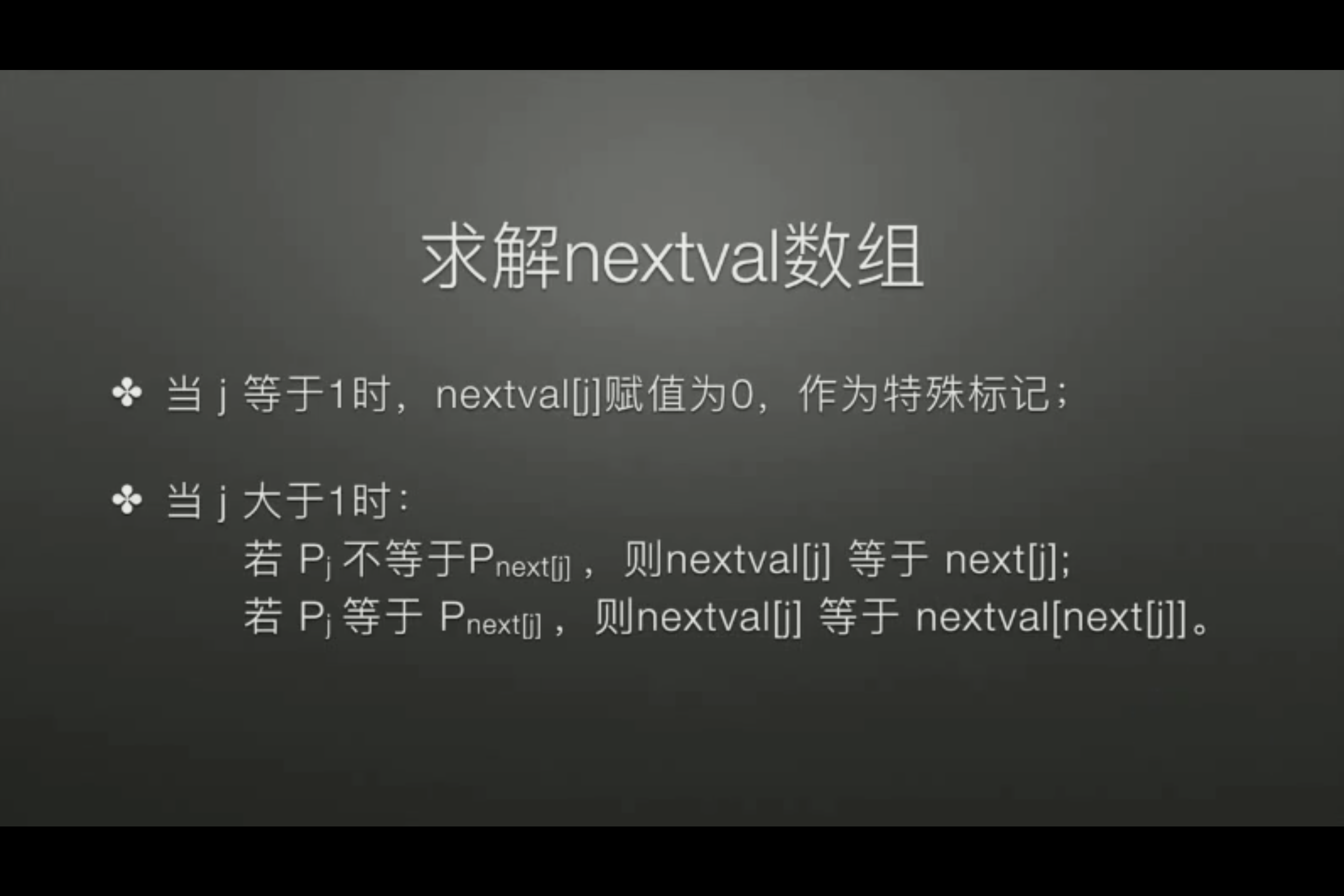
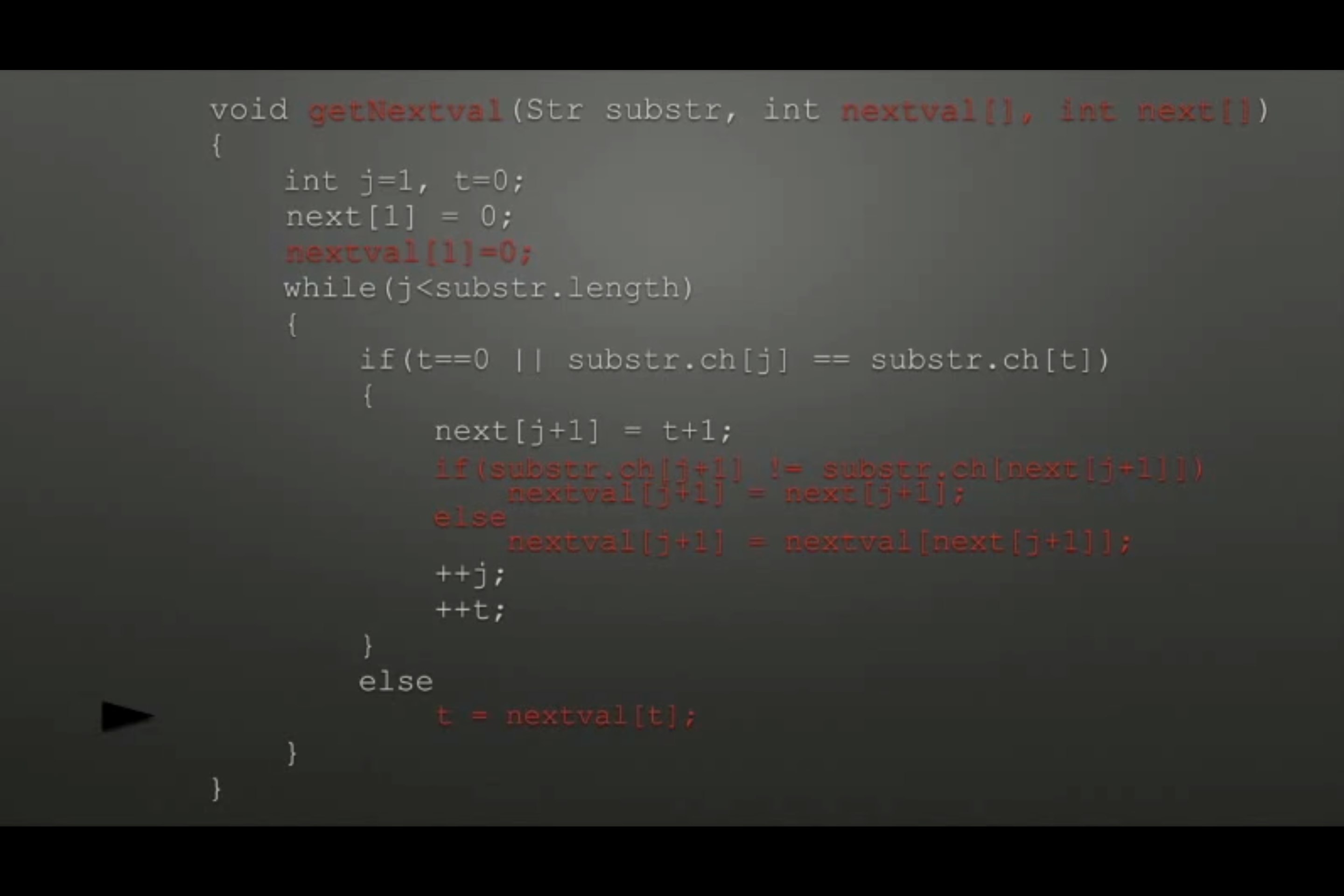
KMP算法的改进(对next数组的改进,升级为next_val数组)
Comments
😅 Commenting is disabled on this post.